Organic vs. Paid Social: Why they’re often confused, and why they shouldn’t be
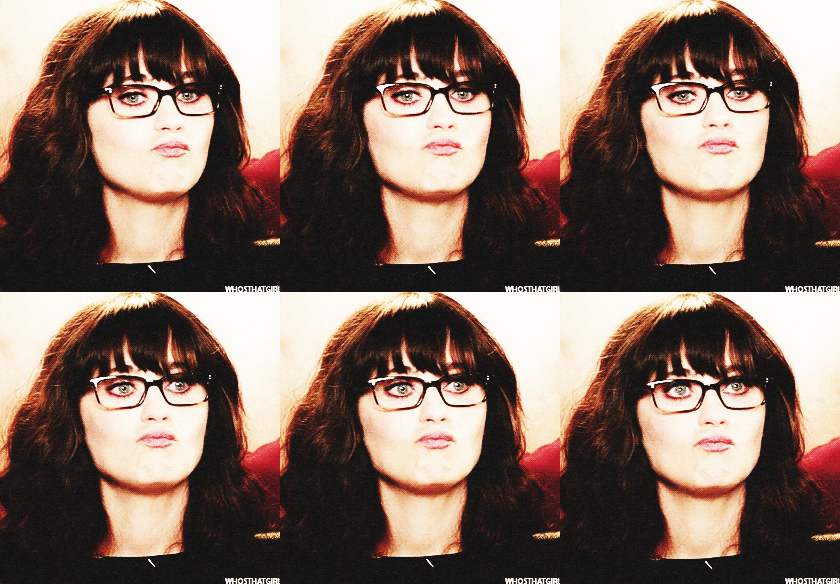
You know those celebrity dopplegängers that people constantly mix up? Or your mom swears is the same person? Like…
Katy Perry and Zoey Deschanel:

Jaime Pressley and Margot Robbie:


Tilda Swinton and Conan O’Brien:

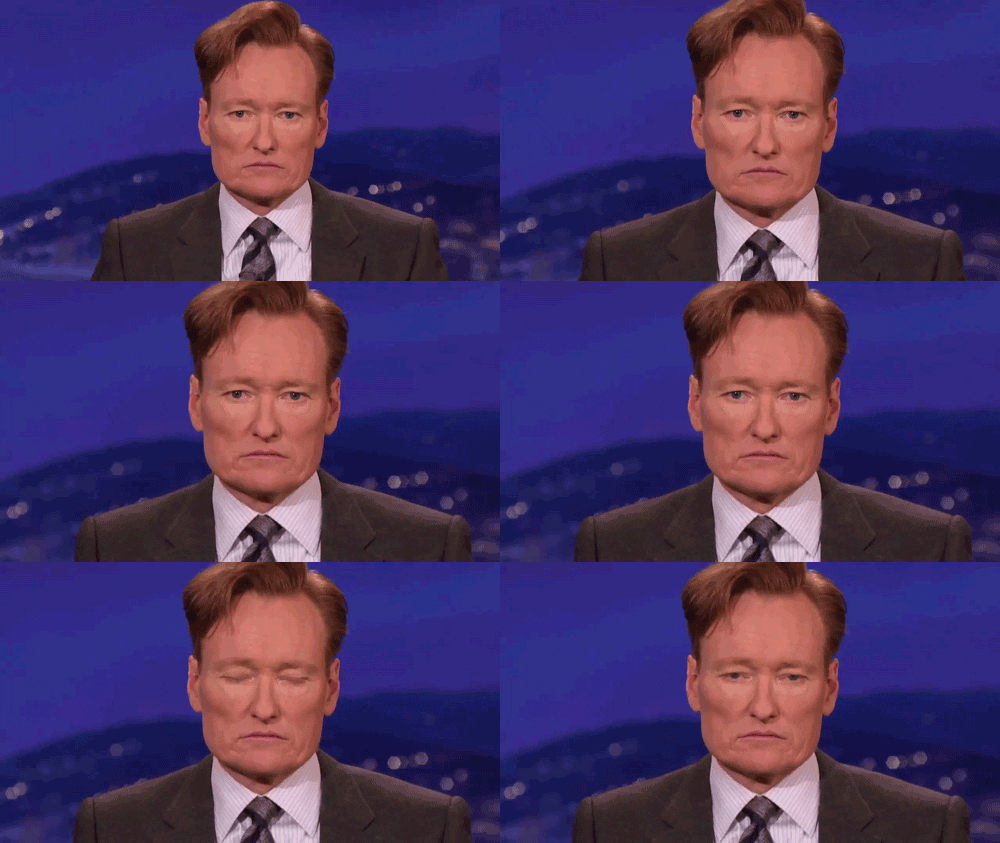
No tea no shade, Conan. I love ya.
…like, I get it! At a glance they look similar. But if you look just a teensy bit closer you’ll see how different they are. That same confusion often happens with organic and paid social.
They’re both happening on the same platforms and showing up in the same feeds, so it’s easy to assume they’re basically interchangeable. But they’re simply built different!
Organic and paid social media get grouped together, talked about like they should work the same way, and expected to deliver the same results… and that’s where strategy starts to fall apart. 😵💫 But they are, in fact, distinct ways of getting visibility to your brand, and should be thought of as two separate pieces of an overall strategy. And until that distinction is clear, it’s really hard to understand what either one is actually meant to do, let alone make them work together effectively.
If you’re already confused, we promise it’ll make sense by the end!
Where the Confusion Starts
When you hear the term “Social Media Marketing,” what do you think of? Is it something like this?
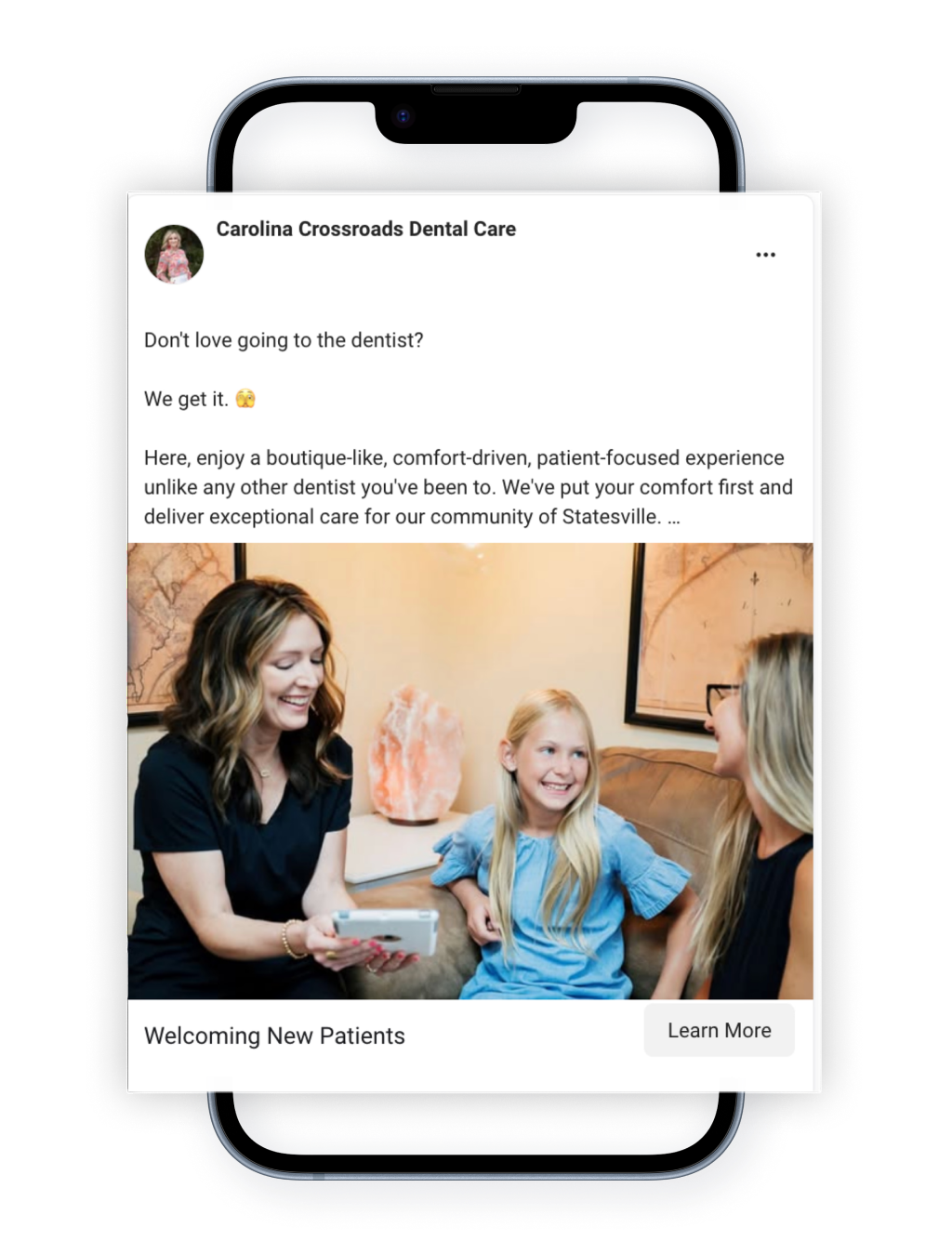
If so, that makes sense! 👆 This right here is polished, direct, and it’s clearly trying to get potential patients to do something—hence the “Learn More” button, which provides a clear path to schedule on their website. It’s giving marketing, no question!
And yes, this is social media marketing. But it’s a paid social advertisement, not an organic social post.

What you’re looking at here isn’t something you’d just casually come across in your feed. It’s a targeted ad, placed there on purpose.
Paid social is designed to do one thing really well: get your practice in front of the right people and drive action, like calls, clicks, or getting new patients through the door! It’s focused, intentional, and very much built to convert. That all sounds great, right!? So why would you even bother with organic social if it’s not driving immediate calls or bookings? What’s the point?
Welp.
They check out your socials. They scroll your posts and try to get a feel for your practice and the people behind it before making the decision to schedule.
The goal of ads is to drive someone straight to your website. But they’re also bringing new eyeballs to your page, your profile, your overall presence! When that happens, people don’t just stop at the website.
So if you’re running ads that bring in new people, but your social presence is nonexistent or you haven’t posted in months, you’re asking someone to trust you without giving them much (if anything) to connect with.
Yes, you’ve got their attention. Not necessarily their trust, though… That’s where the great and powerful organic social comes in!
Organic Social: Where Connection Happens
Remember the example of the paid ad I shared above? Well, here’s a bonafide ✨ organic post ✨ from the same practice, Carolina Crossroads Dental Care:

As you can see, there’s no “Learn More” button here, it’s simply showing who they are. It’s the practice owner out in the community, supporting a cause she genuinely cares about. I know this might not seem like a big deal, but it’s giving potential patients a glimpse into what they stand for outside the office. It’s personality, it’s presence, it’s MEMORABLE!
When someone in her area comes across this organic social post, they’re not being asked to make a decision. They’re just taking it in like anyone else they follow on Facebook. And hey, maybe they love animals, too! Maybe that nonprofit resonates with them.
Whatever it is, it creates a connection. 🤝 So later on, when that same person sees a paid ad from Carolina Crossroads, it doesn’t feel random. There’s already a small sense of trust built in, even if they can’t quite put their finger on why. That right there is what makes paid social work even better!
Alternatively, if you’re running Meta ads, but there’s nothing of substance behind your accounts when potential patients scroll your feed, you become the opposite of memorable.
You got their attention, sure. But you’re not giving them much of a reason to stick around or choose you over the ten other offices they’re probably considering. Organic social is what fills in that gap.
Start thinking about what actually makes you or your practice different. Maybe it’s the causes you support, like Dr. Spears and her involvement with local nonprofits. Maybe it's your team, your humor, your weird office traditions, or the way you hype each other up. Maybe it's the behind-the-scenes stuff — the little moments that make your office feel less like a business and more like a place people actually want to be.
That's your content. That's your difference
In a market that's more saturated than ever, organic social is what gives you that X factor — the thing that makes someone stop scrolling, feel something, and think that's the practice for me! You can't manufacture that with an ad budget. But you can build it, post by post, just by showing up as yourself.
Paid Social: Where Visibility Happens
So, you've been killing it on (organic) social lately! Showing up consistently, posting with personality, and giving potential patients a reason to connect with you (you superstar)! You've got a solid foundation — and paid social is what amplifies it.

Paid social is focused on one thing: visibility. Getting your practice in front of the right people, in the right community, at the right moment, before they even knew they were looking for you. 🤗
What makes that possible is how targeted it can be. Meta's ad platform lets you dial in exactly who sees your content based on location, age, interests, and behaviors. You can put your practice in front of exactly the kind of patients you're looking to attract, in the exact community you serve.

And just like organic social, the what matters just as much as the who. A great paid ad has three things working together: a visual that stops the scroll, copy that speaks directly to the person you're trying to reach, and a clear call to action that tells them exactly what to do next.
Let's break down this paid social ad from Graf Dental Surgery, for example:
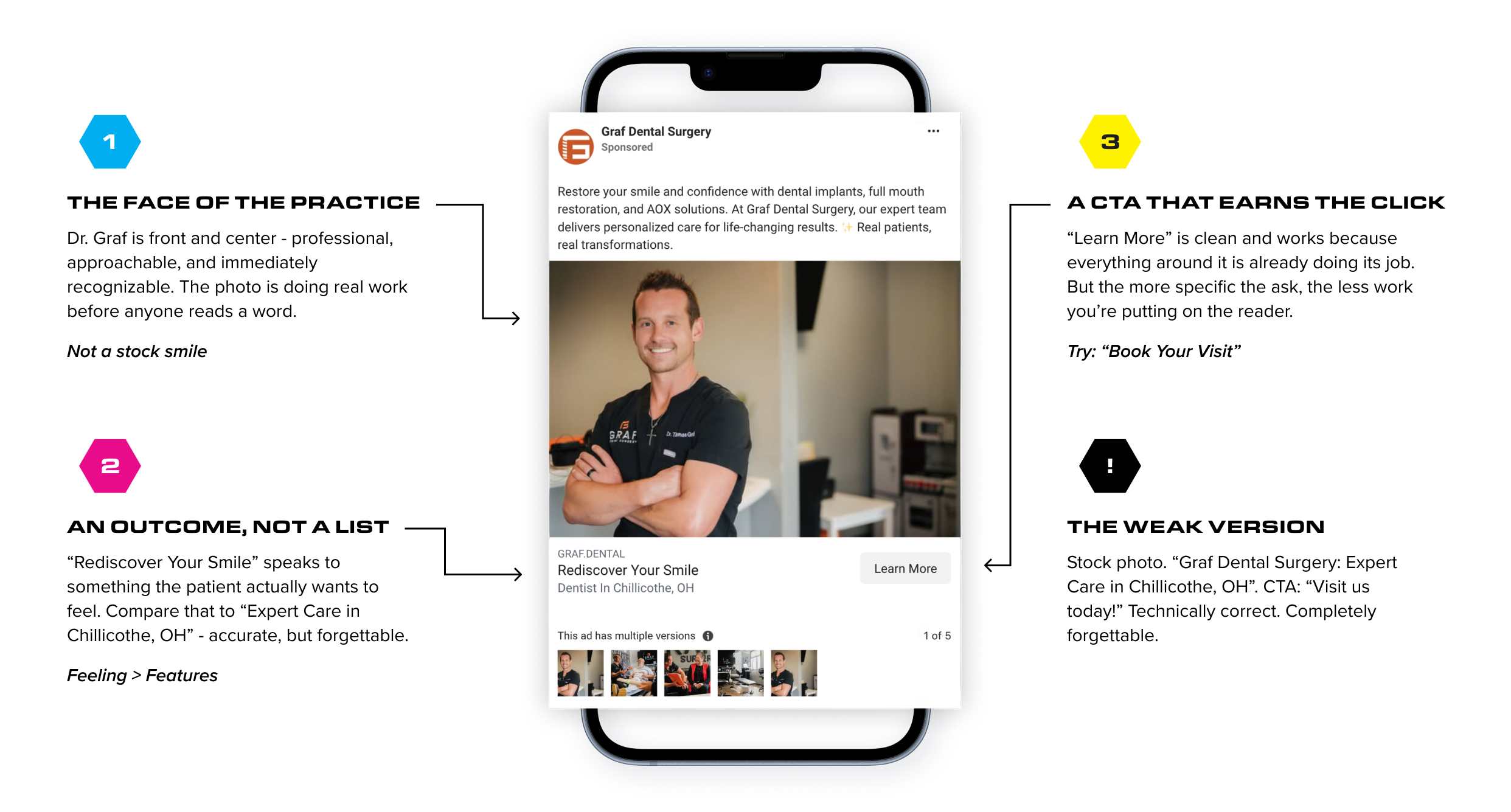
First, the visual. Dr. Graf is front and center, professional, approachable, and immediately recognizable as the face of his practice. That photo is doing a ton of work before anyone reads a single word. Image quality matters a lot. A blurry, poorly lit, or overly casual shot signals the wrong thing before you've even had a chance to say the right thing. Compare that to an ad running a stock photo of a generic smile (yes, it happens 😬), and you can immediately feel the difference in credibility.
Then there's the headline: "Rediscover Your Smile." It's not listing procedures. It's not saying, "We offer dental implants and full mouth restoration." It's speaking to ✨ an outcome✨ something the patient actually wants to experience! That's the difference between copy that converts and copy that gets scrolled past. A weaker version of this ad might lead with something like "Graf Dental Surgery: Expert Care in Chillicothe, OH." It’s technically accurate, but kinda forgettable.
Finally, the CTA. "Learn More" is clean, and it works here because everything around it is already doing its job. The headline hooked them emotionally, the photo built trust, and by the time someone gets to "Learn More" they're not being asked to make a big leap — they're just being given a gentle nudge in the right direction. The hard work was done before they ever got there. Don’t make the mistake of expecting the CTA to do all of that heavy lifting on its own. If your visual is generic, your copy is forgettable, and your headline is just your practice name, no button at the bottom is going to drive the action you're looking for. Think of your CTA as a closing argument, not an opening statement. The rest of your ad has to earn it first.
And when every element is working the way it should, the purpose of the ad itself snaps into focus.
.gif)
If you haven’t had your That’s So Raven moment and still are a bit confused as to why Graf Dental Surgery chose to turn this into a paid ad instead of just posting it organically, here's the answer: it's because that content wasn't meant for the people who already know them!
That post's message wasn't for Dr. Graf’s current patients or his existing followers. It was for the stranger in Chillicothe scrolling Facebook on a Tuesday night who had no idea Graf Dental Surgery existed. Organic social might never reach her. Paid social does.
That's what a great ad (like the one above) is really for. Not to remind your loyal patients why they love you! But to find the people who need you and don't know it yet, and give them a reason to pay attention.
Paid social is what give you assurance that when you've got the right message, the right person actually sees it. In a market where staying top of mind is everything, it’s what gets your practice in front of the people who need you most.
Better Together: Where the Magic Happens
Okay. So now you understand how paid and organic social are very much different animals that serve different purposes. But something we haven't touched on yet is timing — as in, how long each one actually takes to work.
Organic social = long game. Every post you put out is a little deposit into your practice's reputation, building familiarity, trust, and connection over time. It compounds. A post you share today might be the thing that makes someone feel like they know you six months from now, right before they decide to book.
Paid social = the short game. As in, the moment your ad goes live, it's already in front of potentially thousands of people! No slow build or waiting. You get IMMEDIATE visibility. But the moment you stop spending, it stops reaching.
👆 And that is exactly why the two are better together.
Imagine someone discovers your practice through a paid ad, gets curious, and clicks over to your Facebook Page or Instagram. In that moment, your organic presence either does its job or it doesn't. If it's there (consistent, human, full of personality), it's the thing that may convert a stranger into a new patient. If it's not? You bought all that visibility, and there’s nowhere for it to land.
<aside>💡
**Nielsen found that social channels can drive over 70% aided brand recall; meaning the familiarity built through consistent presence is what makes audiences more likely to recognize, trust, and engage when your ads appear.**
</aside>
That's what organic social quietly protects against. It keeps working in the background long after any individual post goes live, so that when someone lands on your page, there's actually something worth finding. And that's not just good for connection — it makes your paid dollars work harder too! One without the other leaves a gap. Together, they cover it.
When you step back and look at it all, the difference between organic and paid social is kind of hard to unsee now, right? Kind of like how McKenna Grace and Kiernan Shipka are NOT the same person despite having the same headband!


Just like these leading ladies, organic and paid social content may live in the same feed, but they’re playing entirely different roles (get it? 😉). Once you see that, it’s hard to miss, and even harder to ignore. The rest is just putting it to work.
If you need help doing that, or want to chat with our team about performance marketing that works together with story-driven creative for predictable growth, we’re always here for ya! Reach out today to start the conversation.