
What Is AI Search? A Down-To-Earth Guide for Dental Practices

Imagine it’s late in your city and someone, somewhere, is going through serious tooth pain. They’re not ready to call a dental practice yet, so they open Google, ask a question, and before they ever see a list of links, Google gives them an answer without them having to click through to a website.
That was most people’s first experience with AI Search, and that was back in 2014 with Google’s Featured Snippets.
Fast forward to 2026: now potential patients have a slew of options to choose from when it comes to AI generated answers, whether it’s ChatGPT, Perplexity, Google’s AI Mode, Google’s AI Overviews, and so very many more.
That means a patient can start forming an opinion about who to call based on an AI answer before they ever reach your website or view your business profile.
This has, understandably, raised some concern among practice owners and marketing teams alike. If patients aren’t even going to your website, won’t you see a drop in organic search leads? Doesn’t that mean your organic traffic will plummet?
While the organic search landscape has certainly shifted, much has actually stayed the same in the realm of SEO. In fact, it’s not a bad idea to think of AI Search as SEOs natural next step, rather than an outright replacement.
The goal is not to try and “hack” ChatGPT or Google for AI Visibility; the goal is to make your practice one of the sources they trust enough to pull from so that you’re being included in the conversations that more and more people are having through chat.
In this article, we’ll cover:
- What AI Search is
- Explain the popular acronyms: AEO, AIO, GEO
- Address where patients conduct AI Searches today
- Touch on the impact AI has had on Local Search
- Share important context about how we got to AI Search from SERPs
- Finish off with how you can view AI Search as a new organic channel
What Is AI Search?
AI Search is when an AI system synthesizes information from across the web to answer a question directly, rather than just showing a list of links. So instead of a patient getting a link to your website, they get their answer directly from the AI.
An AI Search usually goes like this:
- A patient asks a question such as, “I’ve been having tooth pain in my back teeth lately. Is there a trustworthy dentist nearby that can help me figure out why?”
- The system pulls information from places it thinks are credible and relevant, like:
- Authoritative websites (service pages, FAQs, doctor bios, articles)
- Relevant Google Business Profiles (categories, services, reviews)
- Third-party sources (directories, associations, community pages, news mentions, Social Media, etc)
- It produces a summary answer that often:
- Compares options
- Includes sources/citations
- Suggests follow-up questions
- Recommends next steps
Think about it like this: The AI system is doing part of the “research phase” for the patient.
Instead of the patient Googling, the AI Googles for them. If your website and listings don’t answer the real questions patients are likely to ask, you’re less likely to be mentioned in the summary or even considered as an option to include in the answer.
Addressing Popular Misconceptions about AI Search
Before we go on, I’d like to make a few things clear.
- AI Search is not replacing SEO. Pretty much every year, some “guru” publishes an article declaring that SEO has been done in by whatever latest change in organic search is in current headlines. I’d be wary of any self-proclaimed expert saying, “Without AI Search, your practice is going to struggle to get any organic leads.” A good rule of thumb when you encounter this kind of talk is to ask them for specifics, like how AI Search visibility is actually measured and how it really contributes to your patient acquisition funnel.
- AI Search and SEO are not the same thing. On the other side of the spectrum are people who claim that GEO/AEO/AIO are just meaningless acronyms and that you don’t need to do anything different from traditional SEO to appear in AI Answers.
While there is a good amount of overlap, especially when it comes to Google’s AI systems, there is a fundamental difference: SEO deals with retrieving results and displaying them in SERPs, while AI Search deals with synthesizing those results in generated answers. Both start with retrieving sources; the difference lies in their outputs. - Schema Markup does not improve your brand’s AI Search Visibility. It primarily helps clarify details about your brand that might otherwise be hallucinated by large-language models (LLMs) like ChatGPT.
- You do not need to have LLMs.txt on your website to appear in AI Search. This was a misconception that was largely popularized in 2024, even though it was dispelled by Google’s very own John Mueller last year.
AEO, AIO, GEO, AI Search: is there a difference?
Before we get into the acronyms, one quick note: you’re going to see a lot of new labels flying around. Some are helpful shorthand. Others are somewhat derivative.
You can safely assume that if someone is using one of these acronyms over another, it’s largely based on their personal preference, or it might be what their company decided to use for consistency.
At Studio EightyEight, we call our AI Search Services GEO, but we also use some of these other terms interchangeably.
AI Search
What it means: the search experience where a user asks a question and gets a synthesized answer right away, often before they ever see or click a website.
How the term is used: it’s an umbrella label for AI-driven search experiences (AI Overviews, Gemini, AI Mode, ChatGPT, Perplexity; conducting a search in Claude Code would fall into this category as well.
AEO (Answer Engine Optimization)
What it means: the practice of optimizing your website/internet presence for visibility in the answers in AI conversations.
How the term is used: it’s a catch-all label for any process that contributes to digital content (like your website) surfacing in AI Answers.
AIO (AI Optimization)
What it means: Any process that helps optimize your brand’s performance in AI Contexts.
How the term is used: this one can be tricky because it’s used inconsistently. Sometimes people use it in the same way you would use AEO, but sometimes it's used to describe how you can optimize business operations (like content production) using AI. Sometimes it is used in both ways. Sometimes people use it as an acronym for Google’s AI Overviews.
Understandably, that can get confusing, so in the context of you being a practice owner or a marketing lead, the meaningful version is the first one: improving inclusion and accurate representation in AI summaries.
If you’re talking to a vendor and they bring up the term AIO, just make sure to ask them what they mean by that specifically.
GEO (Generative Engine Optimization)
What it means: optimizing digital content so generative AI tools can confidently use your content as source material with accuracy.
How the term is used: Like the rest of these terms, GEO isn’t owned by one person or one shop. You’ll see it used broadly across the SEO industry to describe visibility and representation inside AI-generated answers.
For example, Seer Interactive defines GEO as optimizing an entity to be featured in responses generated by AI tools and features.
That said, different experts emphasize different aspects of what “doing GEO well” means. Mike King from iPullRank’s framing leans heavily into machine-readability, authority signals, and structuring information so it can be extracted and summarized correctly (especially as AI answer search experiences become more prominent).
Where Patients Conduct AI Searches Today
By now, it’s probably settled in that optimizing for AI Search is not just optimizing for one tool or platform. It’s a set of experiences that people have across various AI systems. To help you get clarity on what those systems are, we’re going to define some of the main ones below.
What are Google AI Overviews?
AI Overviews are AI-generated summaries that appear above (or alongside) traditional search results for many informational and comparison-style searches.
Pew Research analyzed Google searches and found that around one-in-five searches in March 2025 produced an AI summary, and that when an AI summary appears, users are less likely to click results.
Separate from Pew’s clickstream analysis, Kevin Indig and Eric Van Buskirk ran an independent usability study watching real users interact with AI Overviews. What they found is that many users treat the overview as the first stop in their search, skim for confidence, and only click deeper when they still feel uncertain.
What this looks like for a patient is pretty straightforward: they get a “good enough” explanation up top, and the click to websites becomes optional.
What are Google AI Mode and Gemini?
AI Mode (powered by Gemini) is a more conversational, follow-up-friendly search experience where the user can keep refining their question for increasingly relevant results. Some believe that Google may eventually make AI Mode the default version of its search experience.
Early referral traffic analysis from iPullRank (using Similarweb data) suggests AI Mode sends dramatically fewer clicks out to external sites than traditional search, which further reinforces the idea that your brand’s influence from AI Visibility can become disconnected from the traffic you get because of it.
This matters because patients don’t always do a bunch of separate searches anymore. They’re more likely to do one “thread” of decision-making.
That’s not just theory. Kevin Indig and Amanda Johnson’s analysis documented patterns that look a lot like conversational refining: users keep iterating inside the experience instead of restarting their search from scratch.
Hypothetically, that thread of questions might look like:
- “Do I need to be seen by a dentist today?”
- “They’re currently closed until tomorrow. What should I do tonight?”
- “What would the dental appointment involve?”
- “How much could the appointment cost?”
What is ChatGPT?
ChatGPT is an AI assistant from OpenAI that most people use to chat with, ask questions, do research, and so much more. It’s the app that finally disrupted Google’s monopoly on Search when it took the world by storm in 2022.
What is Perplexity?
Perplexity is an AI answer engine that behaves more like “search with a summary.” It typically returns a direct answer and shows the sources it pulled from, so users can click through and verify.
Between the other LLMs we’re talking about today, Perplexity is probably the most similar to Google’s AI Mode.
What Using These Tools Looks Like For Patients
Most patients aren’t thinking about tools. They’re thinking about their teeth.
So the behavior is shifting from “read a bunch of websites” to “get oriented fast.” One question turns into a short back-and-forth, the AI system gives a summary that sets expectations, and the patient starts narrowing down options based on trust cues like reviews, proximity, and whether a practice sounds like the right fit.
The final click or the call tends to come later in their search journey when they’re ready to verify something about your practice or actually book an appointment.
What About AI and Local Search?
This topic honestly deserves its own article, and I promise one will be coming soon. But the sparknotes version you should understand right now is this:
Patients still use Google Maps and the Map Pack to find a dentist nearby. When it comes to local search, there’s still a lot of overlap between traditional results and AI results.
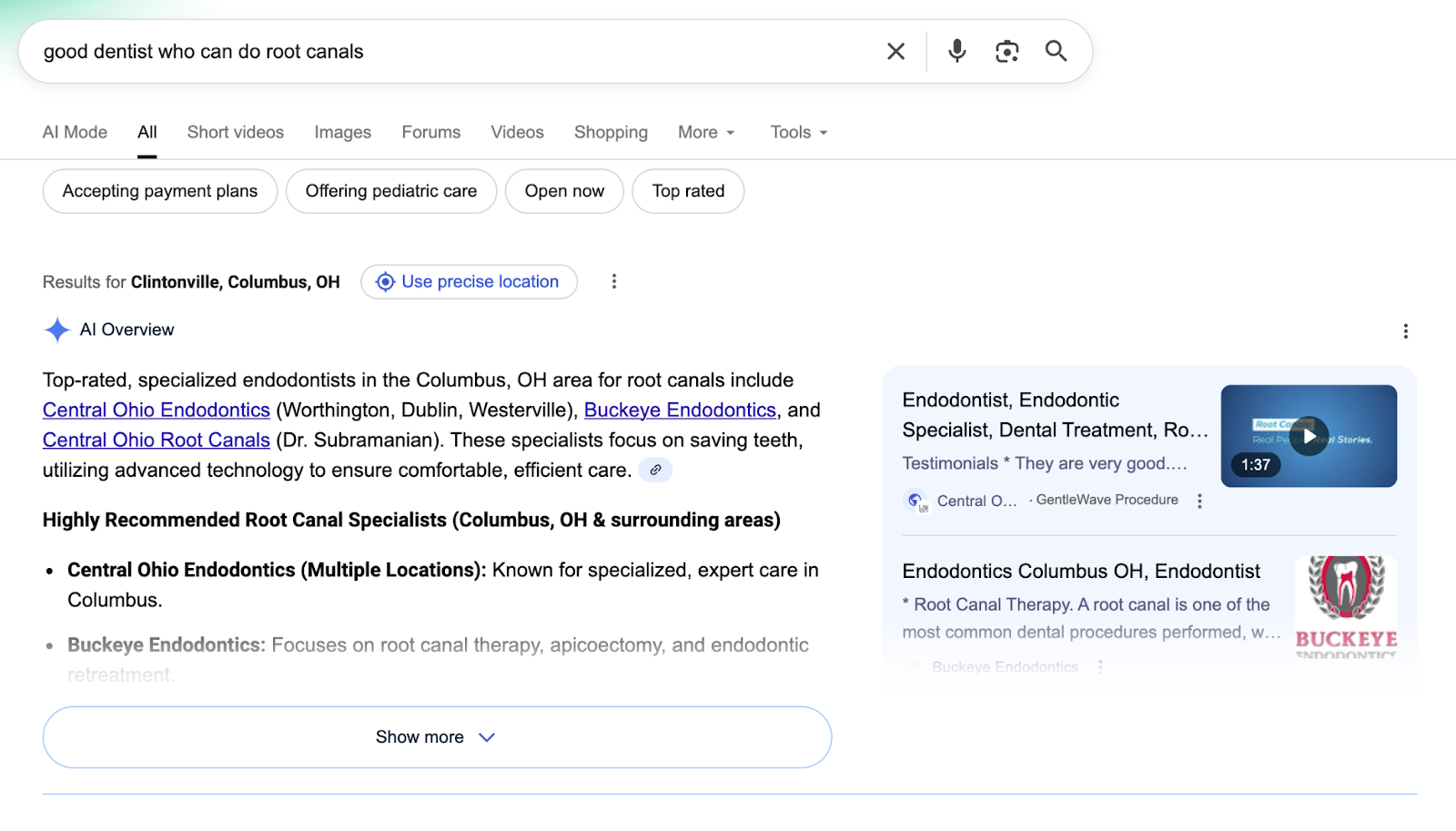
The shift is that Google’s AI features (AI Overviews, and AI Mode) can answer local, “who should I choose?” questions before someone even gets to the map results, especially when the query is more specific than “dentist near me.”
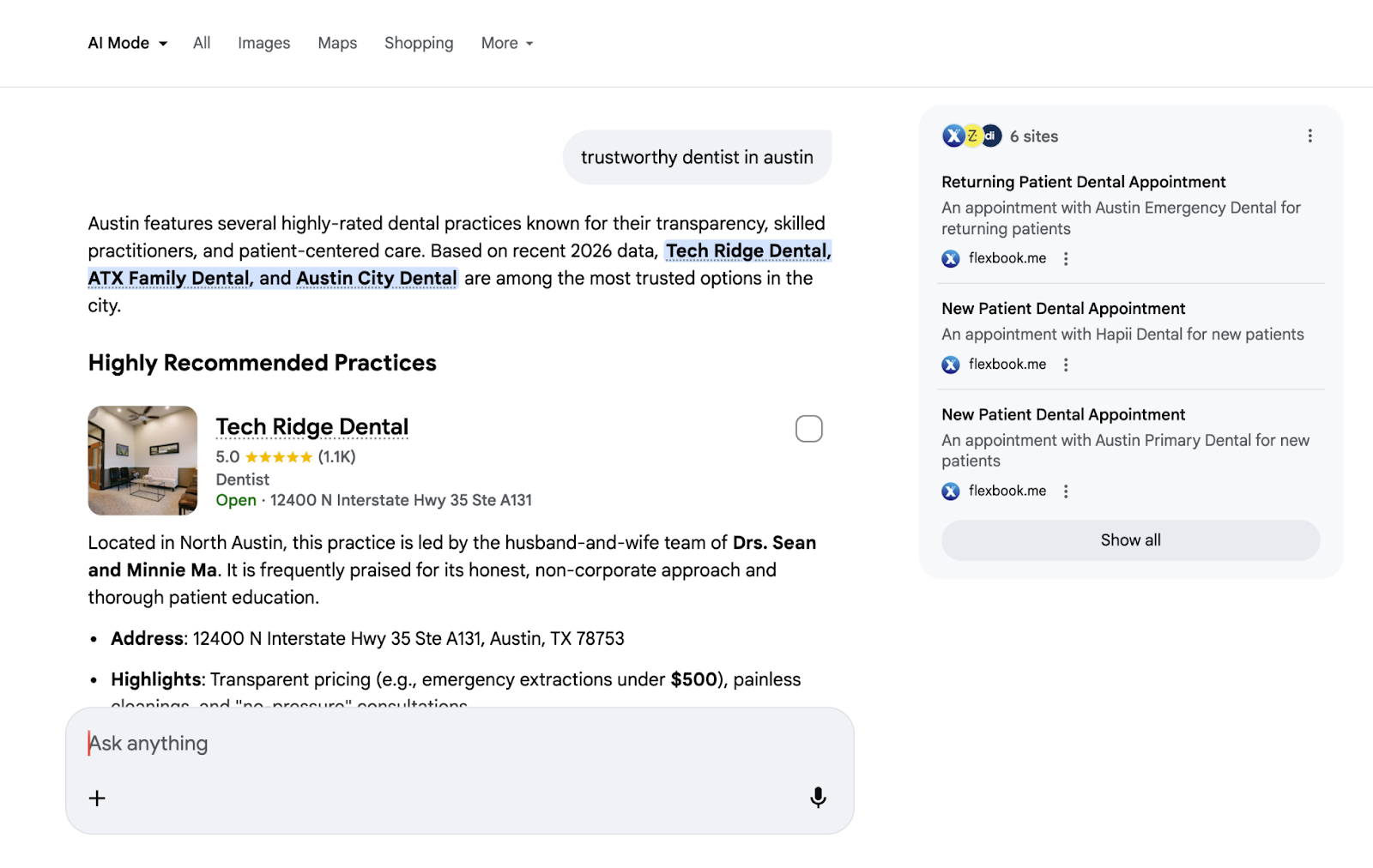
Google itself frames AI Mode as rooted in its existing quality and ranking systems, and describes AI Overviews as using a customized Gemini model working alongside core Search systems. Put simply: traditional SEO efforts will still impact local search visibility, even in AI Answers.
What that means for dental practice owners and their marketing teams:
- The Map Pack isn’t dead: it’s still driven by the same core local ranking factors like relevance, distance, and prominence.
- When AI summaries appear, they change behavior: if patients get an AI answer from a local search, they’re much less likely to click through to your website or even your business profile. That doesn’t mean AI Visibility is hurting your business, but it does make tracking metrics related to AI search journeys more difficult.
- Local “credibility cues” matter because they feed prominence: Google explicitly includes “prominence” (popularity/visibility signals) as a core factor in local results, and reviews and broader reputation also impact your visibility in AI Search.
How We Went From SERPs to AI Search Results
We used to live in simpler times.
Back in the early days of online search, users just asked a question and then they’d get back 10 blue links to choose from. Then came more features, localization, personalization—changes that were meant to make the experience easier for people. Because let’s face it: the traditional search experience was far from ideal.
For one, if you didn’t know how to ask your question in the right way, you may just get irrelevant results. And even when the results were mostly relevant, you had to manually click through several of them to find out which were most relevant, and you might do that only to realize that none of them are exactly what you were looking for.
Search came at a cost to the user. A cost to their time, to their attention, and sometimes mental bandwidth to understand what the results were even saying.
Google has always wanted to make this experience easier for users. They introduced Knowledge Graph so that Google could do a better job connecting facts about people, businesses, places, and other entities, and later on they unleashed BERT in 2019, which was a major leap forward in helping Google interpret the context behind user queries.
Yet even then, search was still more or less the same clunky experience it always was where you typed in a query, scanned results, and clicked through to (hopefully) find the best option.
To go from SERPs to AI Results is by far the biggest change we’ve seen to search to date, and I can’t deny that in most cases, it's a better experience by a long shot.
It’s not perfect. AI still gets things wrong and sycophancy is absolutely a thing to be concerned about, but AI Search takes us one step closer to the search experience we deserve as users.
Now, to say that AI Search is complex is the understatement of the year, so how should you think about it in terms of marketing for your practice?
AI Search as a New Organic Channel
It’s helpful to think of AI Search as a new organic channel—like Local—because it’s another place patients can discover you. The difference is that the “result” you measure isn’t always a click, it's being part of the answer. And that changes what metrics you measure for performance.
With Local, your team is probably used to measuring visibility in terms of avg. rankings, impressions, calls, and website clicks. With AI Search, a lot of the early indicators are closer to:
- Citations: when your site (or profile) is used as a source in an AI answer
- Mentions: when your practice is named even if no one clicks through
- Bot activity: how often AI agents and crawlers are hitting your site and which pages they’re touching
That last one used to be rather difficult to find because it meant working with your dev team to get access to complex server logs, but Microsoft just rolled out an AI Bot Activity view inside Microsoft Clarity that’s specifically meant to show the proportion of traffic coming from automated bots/agents. In short: measuring AI Search performance is starting to sound like more than just noise.
To be clear, none of these metrics replace legitimate conversions or revenue. But they’re useful because they tell you whether you’re being pulled into the conversations that happen before someone picks up the phone or visits your website. You can’t begin to map out a users’ AI Search journey without them.
I’m hoping Google follows suit and gives site owners a clearer dashboard for this kind of visibility and bot-level AI activity over time, because it's data that your SEO teams are absolutely craving right now.
AI Search is already shaping what patients believe before they ever call your dental practice.
But it’s also early, the field still very much being in its nascency, so anyone pretending that AI Search optimization is a settled science is either guessing or selling something.
What isn’t changing is what has always mattered in the end: patients still want clarity, reassurance, and proof they’re in good hands. That lines up with what the data is showing too; research on AI Overviews suggest that “trust in a brand” is the main reason people click out of an AI answer when they want to confirm something on a website or take the next step with a business.
So the practices that will benefit most from AI Search aren’t the ones chasing hacks or gimmicks to try and manipulate AI models.
They’re the ones that are clear about what sets them apart from other practices, their unique approach to their services and treatments, consistent about their local business details, and backed by reputation signals patients already rely on.